Climate Change

POLLUTER PAYS PRINCIPLE

What is the Polluter Pays Principle?

The Polluter Pays Principle is an environmental and economic concept which states that those responsible for pollution i.e. industries, businesses, should bear the cost of managing and correcting the damage caused to the environment and human health.

Originating from the 1992 United Nations Rio Declaration on Environment and  Development, the principle aims to prevent polluters from shifting the burden of pollution onto society and instead parties responsible for environmental damage should face the repercussions of their actions through mitigation, compensation or remedy.

In modern climate policy, the principle is increasingly applied to greenhouse gas emissions through carbon pricing mechanisms such as carbon taxes and emissions trading systems (cap-and-trade).

How to implement the Polluter Pays Principle?

The principle is founded on the idea that pollution costs should not be externalized to communities and future generations. Instead, industries and individuals responsible for environmental harm should pay for prevention, conduct major clean ups, and employ mitigation measures. Examples include factories safely disposing hazardous waste and by products or shipping companies compensating or conducting major clean ups for oil spills into marine ecosystems and mitigating its ecological impact.

‘Polluter Pays Principle’ can be used to tackle a wide range of ecological threats. These include the release of greenhouse gases, air and water pollution by industries, and the loss of natural habitats due to deforestation. Climate change due to greenhouse gas emissions is also an environmental challenge where this principle can be applied.

However, economists consider it a ‘market failure’ since current market prices do not reflect the social and environmental toll of emissions, leaving the public to absorb the resulting health and ecological burdens while polluters evade accountability. To address this, we need to ‘internalise’ the costs of future environmental damage by putting a price on the thing that causes it – namely greenhouse gas emissions.

One way to put a cost on future environmental damage is through carbon pricing often referred to as the social cost of carbon (SCC). It is an estimate of the economic damage caused by the release of an additional ton of carbon dioxide into the atmosphere. A carbon price is an economic policy tool that assigns a financial cost to greenhouse gas emissions, primarily carbon dioxide (CO2) that corresponds to the potential cost incurred through the impact of future climate change events, forcing emitters to take on, or internalise, the cost of pollution thus encouraging industries and businesses to reduce pollution. This can be implemented in two major ways:

  • Carbon taxes, where polluters pay a fixed charge for each tonne of emissions produced.
  • Emissions trading systems (cap-and-trade), where governments set emission limits or ‘cap’ that can be emitted by participating entities for a specific period, and these entities are allowed to purchase emission allowances or carbon credits that they can trade in based on their pollution levels.

These systems encourage cleaner production methods, innovation in green technologies, and investment in sustainable energy solutions. Economists also support global and uniform carbon pricing to prevent companies from relocating to countries with weaker environmental regulations, often called “pollution havens”. However, it should be noted that although it is a great initiative, carbon taxes are politically difficult to impose.

Conclusion

The Polluter Pays Principle is an important tool for promoting environmental responsibility and sustainable development. By ensuring that polluters bear the financial consequences of their actions, the principle helps reduce greenhouse gas emissions, correct market failures, and protect society from environmental harm. Through carbon pricing systems such as taxes and emissions trading, governments can encourage cleaner technologies, support climate action, and create a fairer system where the true costs of pollution are no longer passed on to the public or future generations.

Climate Change

Debt-for-Nature Swaps: A Win-Win for Climate and Development

Debt-for-nature swaps are making headlines as a form of climate finance that reduces a country’s debt in return for environmental commitments. With the cost of mitigating climate change estimated to be between $3-6 trillion a year globally by 2050 according to International Monetary Fund (IMF), innovative financial mechanisms like debt-for-nature swaps are crucial for supporting developing countries in their transition to a more sustainable and climate-resilient economy.

What are Debt-for-Nature Swaps?

These are financial instruments that allow countries to free up fiscal resources to combat climate crisis and protect nature and biodiversity. By doing this, countries can focus on sustainable development without incurring heavy financial burden. Creditors provide debt relief in return for a government’s commitment to decarbonize the economy, invest in climate-resilient infrastructure, or protect biodiversity.

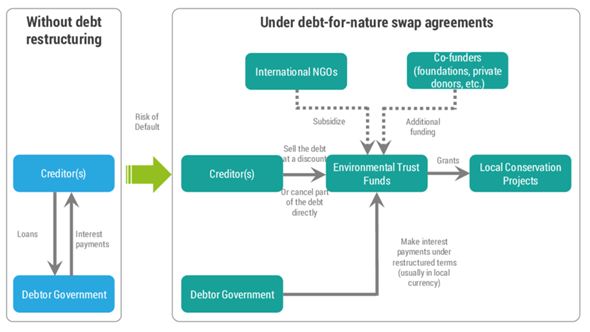
For instance, a debt for nature swap can be an agreement between a creditor (bank or lending government) and debtor (developing country) to allow portions of a debtor’s foreign debt to be forgiven. This is done in exchange for commitments to invest in biodiversity conservation and environmental policy measures. This is most common in instances where debtor countries are at a high risk of defaulting loans and payments.

What are the benefits of debt-for-nature swaps?

A General Illustration of a Debt-for-Nature Swap by Christoph Nedopil

Debt-for-nature swaps offer several benefits. For debtor countries, they provide an opportunity to reduce external debt while investing in environmental conservation and climate change mitigation. For creditor entities, they offer a way to absolve themselves of high-risk debt relations. For the environment, they provide a means to protect biodiversity and promote sustainable development.

Challenges and Limitations

Despite the benefits, debt-for-nature swaps also come with challenges and limitations. Concerns have been raised about the potential risks associated with fluctuating exchange rates, inflation, and fiscal or liquidity crises in debtor countries. Additionally, there are concerns about debtor countries’ potential loss of legislative leverage and sovereignty to foreign entities, especially when bilateral or multilateral swaps are employed. These bonds and swaps can be set aside in favour of the agenda of the creditor and may not align with local conservation needs.

Debt relief can also lead to mismanagement of resources and the risk of corruption especially in low-income countries with a tendency to favour the elite and exclude communities at the grassroot that are primary custodians of natural resources.

Case Studies

Several countries have successfully implemented debt-for-nature swaps. For example, in 1987, Conservation International arranged the world’s first debt-for-nature swap, forgiving a portion of Bolivia’s foreign debt in exchange for the Bolivian government setting aside 3.7 million acres of land adjacent to the Amazon Basin for conservation purposes. In Africa, Seychelles in collaboration with United Nations Development Programme (UNDP), the Global Environment Facility, Global Environment Facility, and the Nature Conservancy was able to protect up to 400,000 km² of ocean through a debt forgiveness of $27 million.

Conclusion

Debt-for-nature swaps offer a promising approach to addressing the climate crisis while promoting sustainable development. While there are challenges and limitations to be addressed, the benefits of debt-for-nature swaps make them an important tool in the fight against climate change. As the global community continues to seek innovative solutions to the climate crisis, debt-for-nature swaps are likely to play an increasingly important role.

Climate Change

CARBON CREDITS & CARBON OFFSETTING

WHAT TO KNOW ABOUT CARBON CREDITS

According to a recent Intergovernmental Panel on Climate Change (IPCC) report, projected global warming may reach 0.8oC to 1.2oC above pre-industrial levels between 2032 and 2052. The rise in temperature is predominantly due to anthropogenic activities such as burning of fossil fuels, deforestation, and industrial emissions.

Companies seeking to offset their greenhouse gas (GHG) emissions have turned to carbon credits and carbon offsets. This is because governments have been pressuring the private sector to limit GHG emissions forcing these companies to turn to financial products that help them offset their environmental footprints through carbon credits and offsets.

What are carbon credits?

Carbon credits life cycle (https://carbonwise.co/how-are-offsets-used-the-life-cycle-of-a-carbon-offset/)

Carbon credits can be thought of as a tradeable permit that allows a polluter to emit one tonne of carbon dioxide or the equivalent amount of a different greenhouse gas. A carbon credit represents the right to emit or release emissions. A single credit represents 1 ton of CO2e (carbon dioxide equivalent) that the company is allowed to emit. They can be purchased by an individual or a company to make up for carbon dioxide emissions that come from industrial production or transport. Meaning institutions can emit carbon dioxide emissions and in exchange the world’s large reserves of forest will soak up the emitted CO2. The tradable component of carbon credits makes it a very lucrative market, known as the carbon market, with revenues of about $95B in 2023 and is projected to grow in the future.

The number of credits issued to a particular company or organization represents its emissions limit. If a company can limit its emissions below its cap, it is considered compliant and has a surplus of carbon credits. These can be retained for future use, or they can be sold immediately into the carbon compliance market overseen by a regulatory body. This market is known as a cap-and-trade market.

If the company cannot keep emissions under its limits, they are non-compliant and must make up that difference. Over-emitters turn to the carbon market to purchase carbon credits from an under-emitter within the cap-and-trade network.

How are Carbon Credits Created?

Carbon credits are based on the cap-and-trade model that was used to reduce sulphur pollution in 1990. They are most often created through agricultural or forestry practices although a credit can be made by nearly any project that reduces, avoids, destroys, or captures emissions. Individuals or companies looking to offset their own GHG emissions can buy these credits through a middleman or those directly capturing the carbon (voluntary market). Carbon credits, meanwhile, make it more expensive for companies in regulated industries to pollute by charging them per unit of carbon they emit, which has the effect of disincentivizing future emissions.

Alternatively, they can buy the credits through compliance or involuntary markets. Involuntary markets are those set up by governments when they set a cap on how many tons of emissions certain sectors such as oil, transport, energy, or waste management, can release. Companies must trade to stay within the limit.

There are about 75 carbon compliant markets in operation around the world.

Regulators, businesses, and environmentalists have debated globalizing a cap-and-trade market for carbon. However, it is challenging to agree on a common time frame, common price, common measurement, and transparency. The voluntary market’s rapid acceleration is largely driven by recent corporate net-zero goals and interest in meeting international climate goals set out in the Paris Agreement to limit global warming to 1.5 degrees Celsius over pre-industrial levels.

Drawbacks of Carbon Credits

Carbon credits can easily be labelled as green washing. A company can claim they have bought carbon credits from a business outside a regulated exchange, and this does not lower the overall amount of GHGs released by buyers. It gives corporations a way to claim they are eco-friendly without reducing their overall emissions.

The voluntary market operates largely unchecked by federal or local regulators. The market does not have a cap on how many tons of emissions can be offset and the driving oversight is a set of standards. There are a few respected standards organizations that validate carbon credits. Verra, a non-profit has set the most widely used standard to validate credits called the Verified Carbon Standard. Since its launch, it has registered 1,750 projects around the world and verified 796M carbon units.

What is carbon off-setting?

Carbon credits and carbon offsets are often mistakenly used interchangeably, but they are not the same. However, the unit of measurement for both is tonnes of CO2e. Carbon credits are a measurement unit to cap emissions while carbon offsets can be thought of as a measurement unit to compensate an organization for investing in green projects or initiatives that remove emissions.

Carbon offsets are designed to help consumers or organizations counteract the impact of future or past emissions. Offsets can also be traded in a voluntary carbon market. Carbon offsets occur when a polluting company invests in a project that reduces GHGs for example a project that deals with sustainable clean energy to counteract the use of fossil fuels. In a nutshell, carbon offsetting cancels out emissions produced in one place with the reduction of emissions in another place i.e. projects such as wind farms or tree planting exercises. Another way to look at it are carbon offsets are a way to make amends for committing an environmental sin of polluting the air with GHG emissions.

According to the World Bank, carbon credits regulate around 18% of the world’s emissions, while carbon offsets track far less than 1%.

It is important to note that offsets are not created or distributed by a specific regulatory body. They are also not limited to individual regulatory jurisdictions and can be traded on any number of voluntary markets around the world.

Conclusion

Carbon credits and carbon offsets are a great incentive theoretically to deter and curb unregulated carbon emissions. However, there needs to be increased monitoring of the projects to ensure adequate absorption and capture of GHGs that these carbon markets propose to be undertaking. In the long run this will make carbon markets a major solution to climate change.

Climate Change

ECO-ANXIETY: CAN CLIMATE CHANGE AFFECT YOUR MENTAL HEALTH?

The first time I heard the phrase eco-anxiety was during a Climate Change workshop I attended. It immediately piqued my interest because I had never thought of the impact climate change may have on our mental health. The more research I did the more I realised that it is quite a prevalent issue especially among the youth. This pushed me to write this article on it to discuss the issues surrounding eco-anxiety and what you can do to manage it.

What is Eco-anxiety?

Eco-anxiety is the chronic or severe fear of environmental damage or ecological disaster. Eco-anxiety is like generalised anxiety and stress, but it is mainly focused on the environment. Inadvertently, this results in a sense of anxiety that is based on the current and predicted state of the environment with regard to climate change.

There is a branch in psychology that deals with eco-anxiety known as eco-psychology which focuses on people’s psychological relationships with the natural environment and its connection to their well-being and health. Many people go to nature to centre and ground themselves so it’s only natural to get anxious when such a sacred sanctuary is threatened. However, it is not listed as a diagnosable mental health disorder, but it still warrants our attention.

The gradual impact of climate change and the impending doom associated with it push people to have anxiety over their future. Anxiety triggers a fight or flight response which requires a quick solution for imminent danger. Therefore, when people observe impacts like rising sea-levels, deforestation or changes in weather patterns it can cause them to feel threatened, scared and unsafe.   

Research shows young people are feeling betrayed by governments and global leaders through their failure to take the necessary action to curb climate change which is exacerbating eco-anxiety among the young. According to an analysis by UN, by 2030 carbon emissions are set to rise by 16% instead of dropping by half which is the requirement to prevent reaching the 1.5°C mark set at COPs meetings.

Effects of Climate Change on Mental Health

Source: Iberdrola

Climate change impact on mental health can manifest in several ways:

Anxiety, depression, substance abuse, post-traumatic stress disorder (PTSD), aggression, feeling hopeless and fearful, and feelings of trauma and shock. Chronic or severe stress can make people prone to other diseases such as high blood pressure, heart disease, sleeping problems, changes in appetite and depression.

Anxiety surrounding environmental issues can stem from real life experiences related to extreme weather such as droughts, hurricanes and wildfires. It hits harder if you have experienced it first-hand or have had loved ones go through it.

In addition, people may feel guilty due to their contribution and that of their generation to environmental degradation. In fact, young people wish to have fewer or no children to avoid them having to inherit a degraded world.

It has been observed that eco-anxiety or eco-angst mainly affects people who work in environmental jobs or as emergency health workers and first responders. Due to the nature of their jobs.

Furthermore, it affects people disproportionately, some people are more predisposed to the effects of climate change. For instance, those in indigenous and coastal communities, in low lying areas and islands and who rely on natural resources for their livelihoods (tourism, fishing and agriculture). Other groups include people of lower socio-economic status, children, young adults and elderly, displaced people, and refugees.

What can you do about eco-anxiety?  

The silver lining in this story comes in the form of what we allow ourselves to consume. We should have access to reliable and factual information albeit in moderation, make greener choices in our day to day lives, team up with like-minded individuals and partake in plant-based diets. Other environmentally conscious practices are cycling and the use of public transport. Calculate your carbon footprint and find ways to reduce it. And finally spend more time in nature the very thing you are fighting so hard to protect and appreciate and build a connection with it. It may not seem like much but this can appease you psychologically and act as a remedy to the situation. Taking positive action can greatly improve our mental health and reduce feelings of hopelessness and helplessness.

Conclusion

It is normal to feel discouraged, angry and helpless over things beyond your control. However, if these feelings are overwhelming and interfere with your daily life it is best to seek medical advice. Moreover, allow yourself to go through the motions and have compassion for yourself. Go a step further and seek emotional and social support which can really boost resilience and optimism.

Climate Change

OF DESERT LOCUSTS AND CLIMATE CHANGE

What are they?

Scientific name: Schistocerca gregaria

Desert locusts are known to be solitary, however, they swarm when there are heavy rains in an arid region. This is because they have access to food as well as conditions that favour their breeding and maturation. A swarm can be made up of billions of locusts and can be as large as cities. For example, in Kenya, a swarm was estimated to be 60km long and 40km wide, which made it roughly four times the size of Nairobi.

In this swarm phase, they are known to eat their own body weight (two grams) in food each day. This makes them highly destructive to crops as they consume their leaves during their migration from one place to another.

What brought on this outbreak?

In May 2018, a powerful cyclone, known as, Mekunu, hit the Arabian Peninsula causing heavy rainfall that created desert lakes in Saudi Arabia. This created an ideal environment of warm, sandy and wet soil, for desert locust eggs to hatch, develop and breed. A period of dry conditions would normally result in the death of these locusts, however, another tropical cyclone, Luban, hit the area in October 2018. This provided a lifeline for the continuation of the first outbreak and enabled the successful breeding of three desert locust generations.

It is this outbreak that spread to Yemen, where due to political instability and an incoherent government response, the outbreak continued uncontrolled. In 2019, winds from another tropical cyclone, Pawan, facilitated the migration of these desert locusts to East Africa. Political instability and limited capacity contributed to the lack of response and made this outbreak, not only the worst in 25 years for Ethiopia and Somalia, but also the worst in 70 years for Kenya.

What is their relationship with climate change?

This outbreak was brought on by the increase in tropical cyclones reaching landfalls all linked to the Indian Ocean Dipole (IOD). The IOD is a climate system that affects the weather in East Africa & the Arab Peninsula, and Indonesia, New Guinea & Australia. The IOD has three phases – positive, negative and neutral. It is the positive phase that is linked to the desert locust outbreak.

In the positive phase, the winds blow east and the waters around East Africa & the Arab Peninsula warm up resulting in cyclones and heavy rainfall in the region. The frequency of cyclones increases during the positive phase due to an increase in warmth and moisture which acts as fuel to these storms.

The IOD was in positive phase in 2018 and 2019 from June to December. However, in 2019, the IOD was at an extreme positive level. This led to not only an increase in rains in East Africa, but also an increase in bushfires in Australia. This is because as it rains in East Africa, Australia develops drought-like conditions.

Research has shown that there has been an increase in positive phases in the IOD over the years. This is linked to human-induced warming of the western Indian Ocean (Africa) in comparison to the eastern Indian Ocean (Australia). This results in heavy rainfall, cyclones and bushfires.

A study conducted in 2009, found that there has been an increase in the frequency of positive IOD phases since the 20th century. According to the study, at the beginning of the 20th century, a positive IOD phase was estimated to occur around 4 times in a 30-year period. However, between 1989-2009 (30-year period), 10 positive IOD phases occurred.

It is estimated that further climate change would only increase the frequency of positive IOD phases by a factor of three by 2099. This will increase the number of locust outbreaks in the Horn of Africa as more cyclones occur feeding into the lifeline of the desert locusts.

CHRIS HANI


Climate Change Food

Climate Change and Food Security

Food security is the state when everyone at all times has the economic and physical access to nutritious, safe and sufficient food to meet their dietary needs and food preferences for an active and healthy life according to FAO.

Food sources can be categorized as agriculture, livestock and fish farming. They all rely heavily on the state of the surrounding environment.

Agriculture

Agriculture is heavily dependent on the weather; it requires the right combination of rain, sun and warmth to produce the food that we all need.

Farmers in sub-Saharan Africa are especially vulnerable to climate change because they rely on rain fed agriculture as opposed to irrigation systems.

Farming is also seasonal as farmers have to harvest before the end of each season in order to prepare for the next.

According to the United Nations, 80% of the world’s food production is by family farms. Therefore, climate change will not only affect these families at an individual level, but the world as a whole.

Factors that affect agriculture:


  • Extreme weather: erratic weather is a hallmark of climate change which can manifest in various ways, i.e., droughts, storms, floods, frosts and heat waves. It is expected that there will be an increase in the intensity and frequency of extreme weather events in the future as the Earth’s atmosphere continues to warm.


  • Pests and diseases: when there is a change in temperature and moisture levels, crop diseases and pests can thrive. One example of a pest is the fall army worm that has invaded farmlands in certain African countries. This is an invasive caterpillar that is known to devastate maize yields.


  • High temperature: average global temperatures should rise in coming decades which would lead to severe desertification and painfully small yields.

Unfortunately, many farmers in developing countries turn to unsustainable avenues to increase their yield such as deforestation, converting natural land to farmland and other unsustainable agricultural practices which lead to a vicious cycle of land degradation and low yields.

Agriculture is a necessity for all humanity because it provides a source of food as well as a primary source of livelihood for around 36% of the world’s total workforce according to FAO. The impacts of climate change are expected to be negative in tropical regions and positive in temperate zones. We may see higher yields in temperate regions which could potentially offset lower yields in tropical zones. However, low income countries with limited financial capacity to trade and high dependence on their own local production of food may find it difficult to offset declines in food supply without a reliance on food aid.

Livestock farming

Heat waves have been known to increase with climate change and this may pose a risk to livestock. The heat can affect livestock directly or indirectly by making them more vulnerable to disease, reduced fertility and reduced milk production. It can also increase the prevalence of parasites and diseases that affect livestock which will lead to the increased use of pesticides that will be introduced to the food chain.

Climate change is a threat to livestock production because it impacts quality of feed crop and forage, animal and milk production, water availability, livestock disease and animal production. Due to an increase in temperature and carbon dioxide the quantity and quality of feed will be affected.

Ironically, the livestock sector is also perilous to the environment by emitting 14.5% of global greenhouse gases and contributing to land use change.

Fisheries

Fisheries are already under stress with overfishing and water pollution. With aquatic waters warming, many aquatic species have been forced to search for colder areas of streams and lakes or move to higher latitudes where temperatures could be more conducive for their survival. This potentially could put them in competition with other species for food and other resources. Trout and salmon are examples of fish losing their habitat due to the migration of warm water fish into cold water regions.

There will be changes in catch size of sea food as fish species change their geographic distribution and migration patterns due to climate change. This can impact national incomes of countries that solely rely on fisheries.

Conclusion

Climate smart agriculture (CSA) is a solution to aid farmers in the wake of the climate crisis. By implementing climate change adaptation and mitigation measures such as ecological farming, agroforestry, crop rotation and more; sustainable agriculture could be achieved which will go a long way with improving food security in several countries.

Additional information on CSA

There are three pillars of CSA, namely, productivity, adaptation and mitigation. CSA aims to increase agricultural productivity and incomes sustainably, reduce farmers exposure to short-term risks, and reduce greenhouse gas emissions. A successful case of CSA intervention is the development of drought-tolerant maize for Africa (DTMA). This has seen the development and successful farming of drought-resistant maize varieties in Sub-Saharan Africa.

In livestock farming, CSA, is achieved through better feeding using crop by-products, agroforestry, fodder banks and improved pastures species. A successful case of CSA intervention in livestock farming, is the East Africa Dairy Development Project (EADD). The project supports about 200,000 farmers by increasing their milk production in Kenya, Uganda and Rwanda.

In fisheries, catfish aquaculture is seen as the alternative source of protein for mankind. Catfish aquaculture consumer less water per tonne, has few impacts on water quality, and allows the use of both wastewater and discarded fish parts as fertilizer and animal feed/oil respectively. Catfish aquaculture has proven to be a successful CSA intervention in countries like Vietnam generating 1 million tonnes of food every year and employing over 170,000 people.

To Our Esteemed Readers: We would like to open the floor to all of you, kindly comment below what topic you would like us to write about in the next blog.

Can’t wait to hear your ideas 🙂


Posts pagination

Welcome To Terra's Liege. If you can't reuse it, refuse it.

X