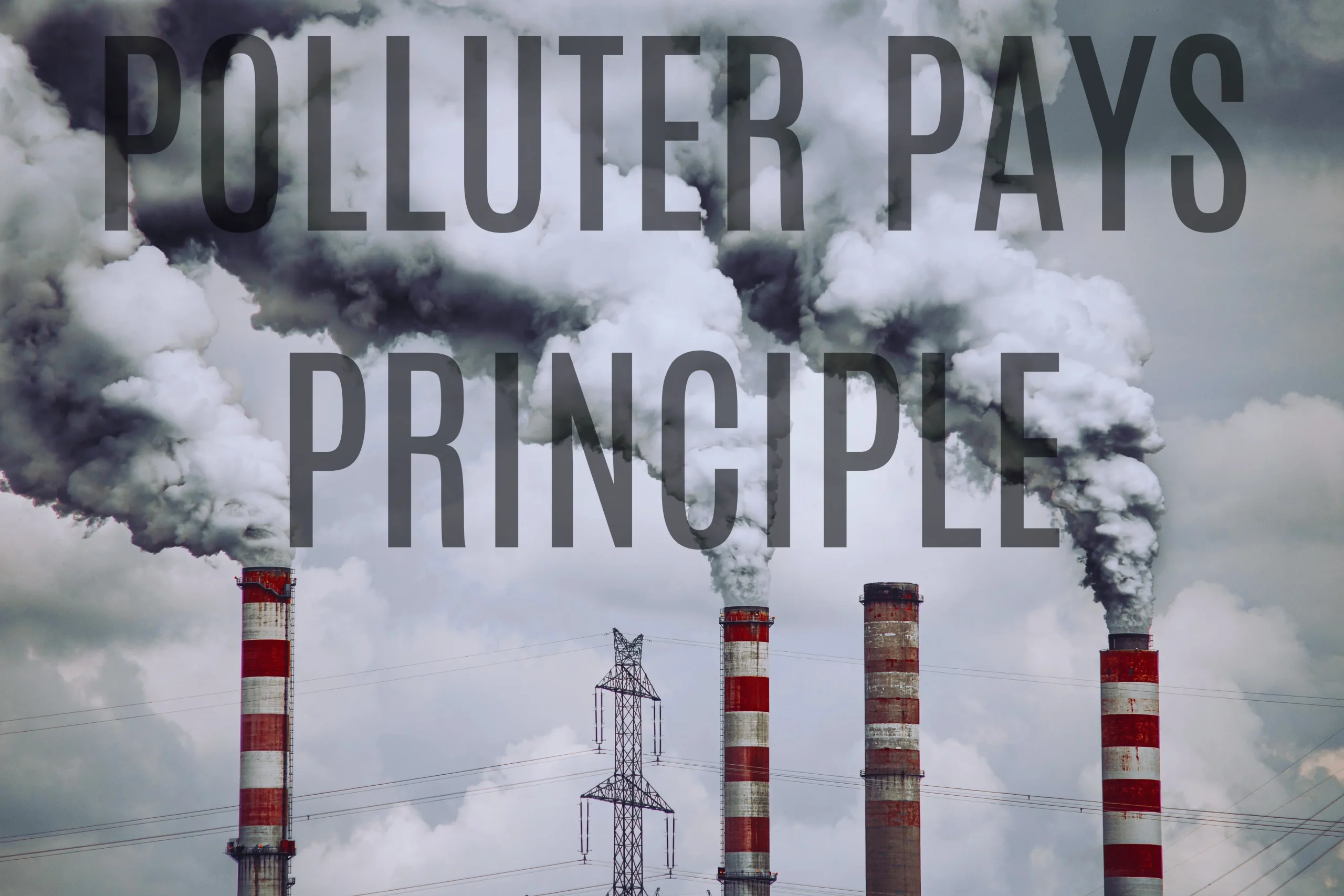
What is the Polluter Pays Principle?
The Polluter Pays Principle is an environmental and economic concept which states that those responsible for pollution i.e. industries, businesses, should bear the cost of managing and correcting the damage caused to the environment and human health.
Originating from the 1992 United Nations Rio Declaration on Environment and Development, the principle aims to prevent polluters from shifting the burden of pollution onto society and instead parties responsible for environmental damage should face the repercussions of their actions through mitigation, compensation or remedy.
In modern climate policy, the principle is increasingly applied to greenhouse gas emissions through carbon pricing mechanisms such as carbon taxes and emissions trading systems (cap-and-trade).
How to implement the Polluter Pays Principle?
The principle is founded on the idea that pollution costs should not be externalized to communities and future generations. Instead, industries and individuals responsible for environmental harm should pay for prevention, conduct major clean ups, and employ mitigation measures. Examples include factories safely disposing hazardous waste and by products or shipping companies compensating or conducting major clean ups for oil spills into marine ecosystems and mitigating its ecological impact.
‘Polluter Pays Principle’ can be used to tackle a wide range of ecological threats. These include the release of greenhouse gases, air and water pollution by industries, and the loss of natural habitats due to deforestation. Climate change due to greenhouse gas emissions is also an environmental challenge where this principle can be applied.
However, economists consider it a ‘market failure’ since current market prices do not reflect the social and environmental toll of emissions, leaving the public to absorb the resulting health and ecological burdens while polluters evade accountability. To address this, we need to ‘internalise’ the costs of future environmental damage by putting a price on the thing that causes it – namely greenhouse gas emissions.
One way to put a cost on future environmental damage is through carbon pricing often referred to as the social cost of carbon (SCC). It is an estimate of the economic damage caused by the release of an additional ton of carbon dioxide into the atmosphere. A carbon price is an economic policy tool that assigns a financial cost to greenhouse gas emissions, primarily carbon dioxide (CO2) that corresponds to the potential cost incurred through the impact of future climate change events, forcing emitters to take on, or internalise, the cost of pollution thus encouraging industries and businesses to reduce pollution. This can be implemented in two major ways:
- Carbon taxes, where polluters pay a fixed charge for each tonne of emissions produced.
- Emissions trading systems (cap-and-trade), where governments set emission limits or ‘cap’ that can be emitted by participating entities for a specific period, and these entities are allowed to purchase emission allowances or carbon credits that they can trade in based on their pollution levels.
These systems encourage cleaner production methods, innovation in green technologies, and investment in sustainable energy solutions. Economists also support global and uniform carbon pricing to prevent companies from relocating to countries with weaker environmental regulations, often called “pollution havens”. However, it should be noted that although it is a great initiative, carbon taxes are politically difficult to impose.
Conclusion
The Polluter Pays Principle is an important tool for promoting environmental responsibility and sustainable development. By ensuring that polluters bear the financial consequences of their actions, the principle helps reduce greenhouse gas emissions, correct market failures, and protect society from environmental harm. Through carbon pricing systems such as taxes and emissions trading, governments can encourage cleaner technologies, support climate action, and create a fairer system where the true costs of pollution are no longer passed on to the public or future generations.